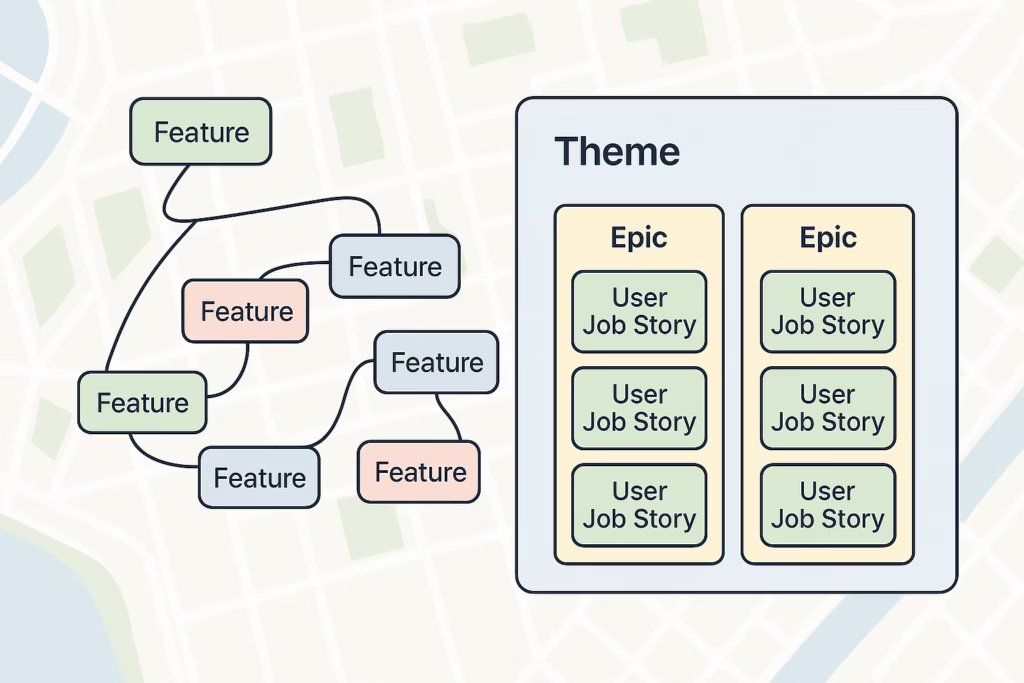
To consistently deliver value in fast-paced product environments, teams must go beyond managing lists of features. A structured backlog—organized by Theme → Epic → User Job Story—brings clarity, focus, and traceability. This layered structure helps align cross-functional stakeholders around strategic outcomes and user context while reducing wasteful work.
The Problem with Flat Feature Backlogs: Lost the Bird’s-Eye View
Many product teams organize their backlog as a long, flat list of features. While seemingly straightforward, this approach quickly becomes unmanageable as the product scales.
The core issue? You lose the bird’s-eye view.
Without structure and grouping, the backlog becomes a collection of disconnected tasks. There’s no narrative. No hierarchy. No sense of how individual items contribute to broader goals. Teams see hundreds of trees—but no forest.
This creates several compounding problems:
- No clear scope: Without themes or categories, it’s nearly impossible to understand what the product is or is becoming. This limits strategic thinking and undermines long-term planning.
- Unclear priorities: In a flat list, everything looks equally important. A one-hour UI tweak and a core architectural upgrade sit side by side—without any indication of business value or urgency.
- Lost context: Over time, teams forget why an item was added. The backlog becomes a graveyard of half-written tickets and outdated assumptions, detached from customer pain or opportunity.
- Siloed decisions: With no shared structure, functions like Sales, Marketing, Engineering, and Product interpret the roadmap differently. This leads to misalignment, duplicated work, and inconsistent messaging.
- Difficult storytelling: Leaders can’t easily communicate progress to stakeholders or investors. What’s done? What’s coming? What matters? The backlog can’t answer these questions.
- Hidden platform value: If a team works on several products in parallel, a flat backlog hides shared components or reusable features that could benefit other teams or strengthen the entire platform. Opportunities for leverage and collaboration go unnoticed.
In short, flat feature backlogs obscure the product’s strategic intent. They reflect a bottom-up perspective rather than a bird’s-eye view. The result? Fragmented delivery and increasing manageability risks as the product scales.
Themes, Epics, and UJS: A Structured Approach
To mitigate these problems, high-performing teams use a hierarchical backlog that maps work to purpose:
- Themes represent strategic focus areas that align with business and product goals.
- Epics define major business capabilities or areas of improvement.
- User Job Stories (UJS) represent the smallest units of customer value, written in context. In line with Agile principles, each story should be small enough to be delivered in less than one sprint—ensuring fast feedback, continuous flow, and measurable progress.
This structure makes backlogs easier to navigate and ensures prioritization reflects business impact.
| Dimension | Flat Feature Backlog | Structured Backlog (Theme > Epic > UJS) |
|---|---|---|
| Viewpoint | Isolated, task-level view (can’t see the big picture) | Strategic bird’s-eye view of product direction and value |
| Scope Visibility | Blurred—scope is inferred from scattered tickets | Clear—groupings reveal product areas and functional scope |
| Prioritization | Lacks comparative value—everything competes on the same level | Prioritized by value, urgency, and risk within strategic themes |
| Context | Frequently lost or buried in comments | Embedded in every layer: persona, goal, metrics, and dependencies |
| Cross-Team Alignment | Difficult—each function interprets backlog differently | Easier—shared language and hierarchy for sales, product, marketing, engineering |
| Storytelling | Incoherent—hard to explain status, direction, or outcomes | Cohesive—makes progress easy to report and rationale easy to defend |
| Platform Leverage | Missed—shared features are invisible or duplicated | Highlighted—shared components surfaced and reused across teams |
| Customer Relevance | Often unclear or speculative | Centered around concrete user actions and value (via UJS+) |
| Technical, Security & Non-functional Risks | Buried in implementation details | Identified upfront at Theme or Epic level |
Comparison Table: Flat Feature Backlog vs. Structured Backlog (Theme > Epic > UJS).
Themes: Strategic Orientation
Themes answer the question: “What business outcome are we working toward?” Examples might include:
- Accelerate onboarding experience.
- Improve account retention.
- Enable upsell through better reporting.
- Improve user administration, security, and compliance.
Themes should remain stable over time and connect directly to OKRs or broader company goals. They create a portfolio view of what the product team is trying to accomplish.
Epics: Functional Initiatives
Epics are workstreams that support a theme. They might cover:
- A new capability.
- A redesign of an existing workflow.
- A major system upgrade.
For instance, under the “Accelerate onboarding” theme, you might see an epic like “Self-serve onboarding wizard.” Epics group related efforts and provide a bridge between vision and execution.
User Job Stories (UJS): Execution with User Context
At the story level, the User Job Story format provides user-centric granularity:
As a [role/persona], when [situation], I want to [action], so I can [expected outcome].
This format, used consistently in the New Business Modelling Framework (NBMF), ensures every backlog item is actionable, testable, and anchored in real user behavior.
Unlike feature descriptions that emphasize system capabilities, UJS entries emphasize what the user is trying to accomplish in a given context. This promotes empathetic design and disciplined prioritization.
Why UJS Works Better than Traditional User Stories
Traditional user stories often start with personas but miss context. For example:
“As a user, I want to receive notifications.”
Compare that with a structured UJS:
“As a team manager, when I assign a task to a new member, I want to receive confirmation, so I can be confident it’s not missed.”
The difference lies in precision. UJS captures the trigger, the intent, and the desired result—allowing teams to prioritize based on real scenarios rather than abstract desires.
Enabling Cross-Functional Alignment
Organizing the backlog this way supports transparency and ownership:
| Stakeholder | What Themes Answer | What Epics Provide | How UJS Helps |
|---|---|---|---|
| Product | What problems matter | What we’ll build | Why users care |
| Engineering | What matters most | Architecture scope | Design and delivery context |
| Marketing | What drives value | Target personas | Messaging alignment |
| Sales | What’s being improved | Use case stories | Selling new value |
This alignment boosts product value, improves collaboration, and grows confidence in the roadmap.
Prioritization with Weighted Scoring
Once structured, Themes, Epics, and User Job Stories in backlogs can be prioritized. One of the simplest methods is called Scrum Poker. It uses Weighted Business+Technical Score, which combines value, urgency, and risk with story implementation points:
| Metric | Definition | Example Score |
|---|---|---|
| Value | Impact for the user or business | 5 |
| Urgency | Time-sensitivity or strategic dependency | 3 |
| Risk | Learning value or mitigation potential | 4 |
| Development Effort | Implementation difficulty (story points) | 8 |
| Score | (Value + Urgency + Risk) ÷ Effort | 1.5 |
We discuss 20+ prioritization techniques in this article. This helps product teams avoid gut-feel decisions and prioritize work that balances impact and feasibility.
Tracing Features to Research and Strategy
Each UJS should trace back to:
- Customer Interviews (goals, tasks/jobs, pains, objections).
- Customer Journey Maps.
- Empathy Maps.
- Persona Objectives.
- Detailed Persona’s Jobs to be Done and Pain Points.
The NBMF explicitly recommends using these artifacts. It helps to de-bias prioritization and ensure backlog items reflect validated user needs—not stakeholder opinions.
“Do not talk about the product idea/solution during the interview… It can alter the other person’s perception.”
This discipline allows teams to trace every feature back to a real-world scenario.
Lifecycle of a UJS: From Pending to Finished
The structured backlog also enables clean transitions across development phases:
- Pending: A raw job story captured from research
- To-do: Prioritized for a future sprint
- Discussing: Validated and shaped with stakeholders
- Developing: In active implementation
- Confirming: Delivered for testing/validation
- Finished: Accepted and deployed
Each stage includes user feedback loops and acceptance criteria—making the process transparent and traceable.
Example: Extended Backlog Elements for Theme, Epic, and UJS+
Below is an example of how an extended backlog can be documented for each level.
Product Theme
| Category | Description |
|---|---|
| Problem / Opportunity | 2–3 sentence summary of the market or tech gap |
| Strategic Outcome | Clear, measurable end-state |
| Success KPIs | 2–4 leading (future performance) and lagging (past results and outcomes) indicators |
| In-Scope Areas | Bullet list of capabilities included |
| Out-of-Scope | Clarifies misinterpretations early |
| Key Epics | Links or lists of child Epics |
| Primary Personas | Who benefits and what they aim to achieve (Jobs to Be Done) |
| Dependencies | Platform, team, or upstream system dependencies |
| Milestone / Timebox | Target quarter or program increment |
| Compliance / Risk | Notes on regulation or technical constraints |
| Open Questions | Living list of assumptions or unresolved issues |
Product Epic
| Category | Description |
|---|---|
| Problem Statement | 1–2 sentence articulation of user or business pain |
| Success Metrics | Primary KPI(s) this epic aims to move |
| Solution Sketch | Outline or diagram of the proposed approach |
| Milestone Map | List of linked expanded User Job Story Plus (UJS+) |
| Risks & Assumptions | Known unknowns or things that may impact delivery |
User Job Story Plus (UJS+)
| Category | Description |
|---|---|
| User Job Story | Format: As a [role], when [situation], I want to [action], so I can [outcome] |
| Business Value / KPI | Measurable goal tied to this UJS |
| Acceptance Criteria | Testable conditions, e.g., in Gherkin format (Given/When/Then) |
| UX / API Assets | Links to wireframes, API definitions, or other assets |
| Functional Notes | Calculations, edge cases, constraints |
| Non-Functional Needs | Security, performance, analytics, i18n (US abbreviation for internationalization and localization), etc. |
| Dependencies | Rollout plans, flags, upstream feature readiness |
| Out of Scope | Prevents gold-plating (adding features outside of initial plan to please users) or feature creep (uncontrolled changes or expansions to your feature scope without adjusting the project’s time, cost, or other resources) |
| Tech Ticket | Link to the development task (e.g., in Jira) |
Final Thoughts
Themes, epics, and user job stories bring structure, context, and alignment to product development. They help teams prioritize what truly matters to users and the business—without drowning in feature noise.
By adopting this structured approach, product and revenue leaders can accelerate time to value, reduce waste, and improve strategic execution.
🗨️Have you implemented a backlog based on Themes, Epics and User Job Stories? What frameworks or scoring models have worked best for your team? Share your challenges and successes in the comments. And don’t forget to subscribe to our newsletter for more frameworks and strategic product insights.
Updated on June 9, 2026